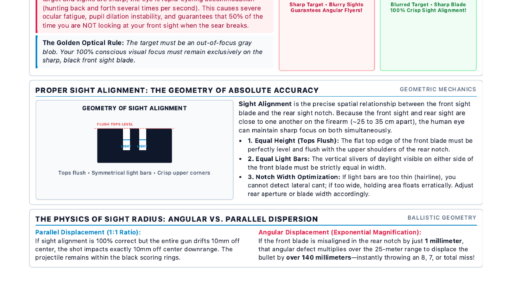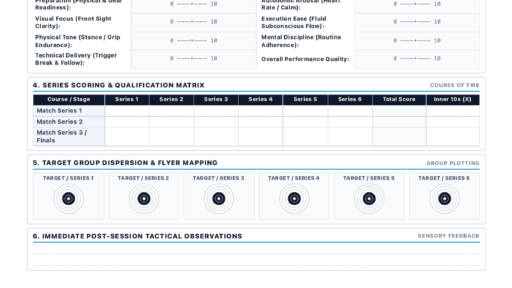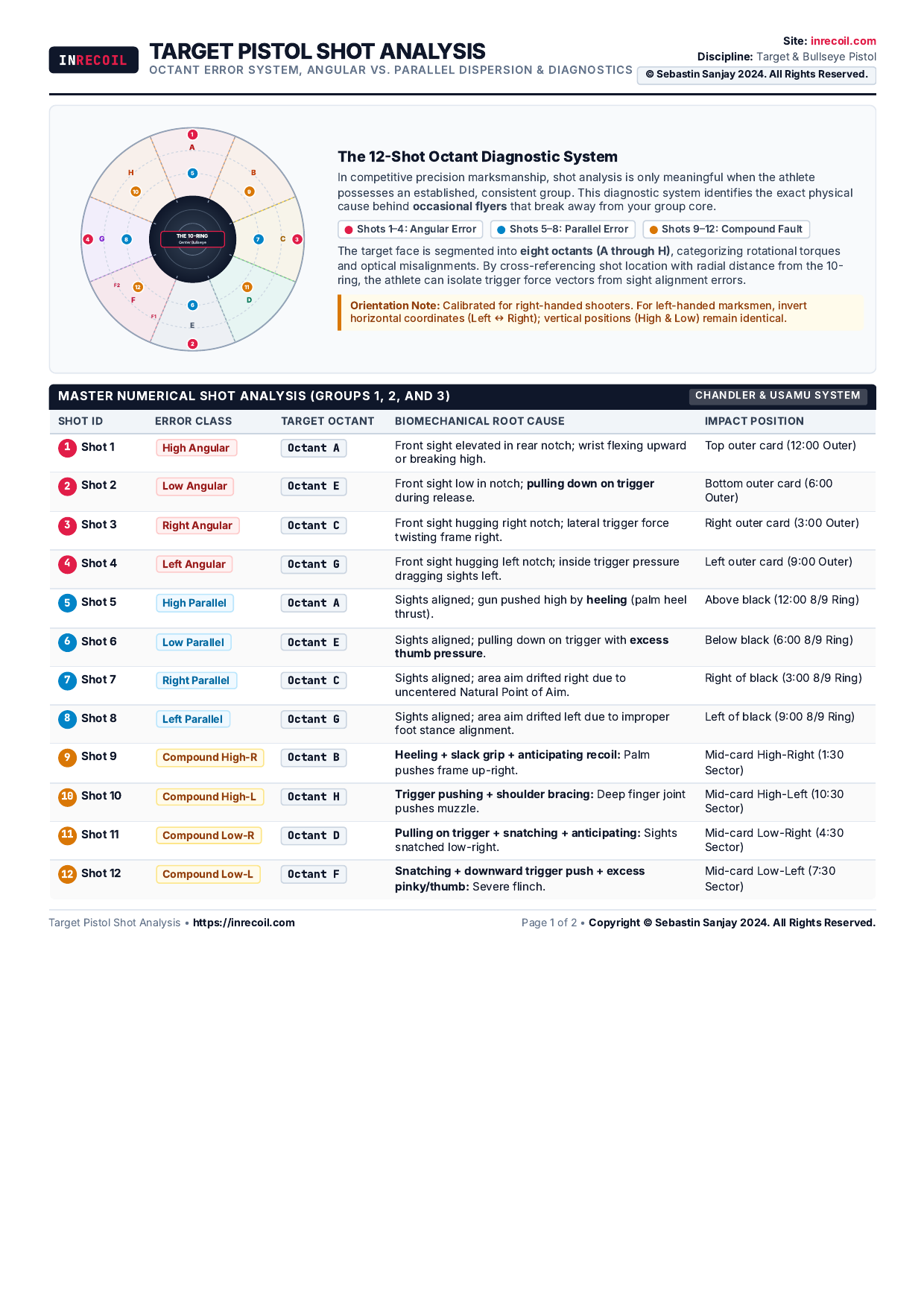

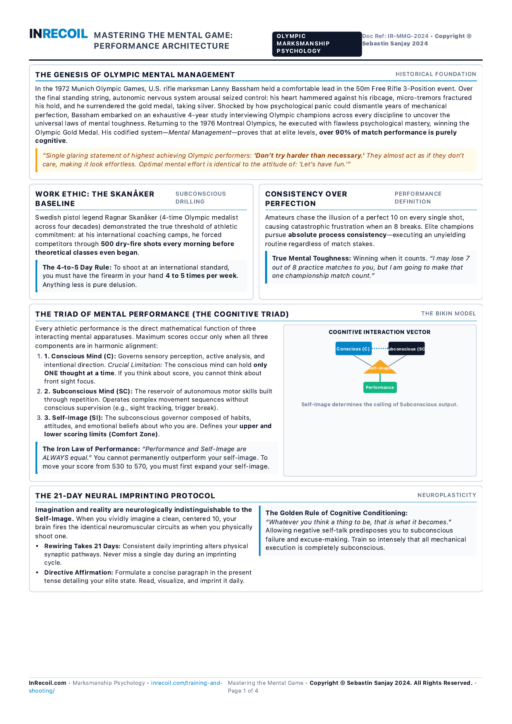

In target marksmanship, mechanical precision accounts for only a fraction of competitive success—the championship is won or lost in the six inches between your ears. An athlete can possess an Olympic-grade custom grip, pristine SCATT holding traces, and thousands of hours of dry-fire experience, yet completely disintegrate on the firing line when autonomic pressure strikes. Why do shooters who effortlessly shoot 580 in practice drop to 540 in competition finals? The answer lies not in physical flaws, but in a failure of cognitive architecture. At InRecoil, we are proud to publish the official Mastering the Mental Game: Performance Architecture Manual, authored by Sebastin Sanjay (Copyright © Sebastin Sanjay 2024), available as a high-resolution 4-page downloadable PDF reference guide.
[box]
Download the Official Mastering the Mental Game Manual (PDF)
Get the complete 4-page executive coaching manual designed exclusively for InRecoil. Features the Triad of Mental Performance (Conscious, Subconscious, Self-Image), the 5-point Olympic pre-shot mental program, rapid parasympathetic centering protocols, behavioral style profiles, and 21-day self-image imprinting blueprints.
[button url=”https://inrecoil.com/wp-content/uploads/2026/11/inrecoil-mastering-the-mental-game.pdf” text=”Download Free Mental Game Guide (PDF)”] [button url=”https://inrecoil.com/training-and-shooting/training-overview/” text=”Explore Complete Training Hub”]
[/box]
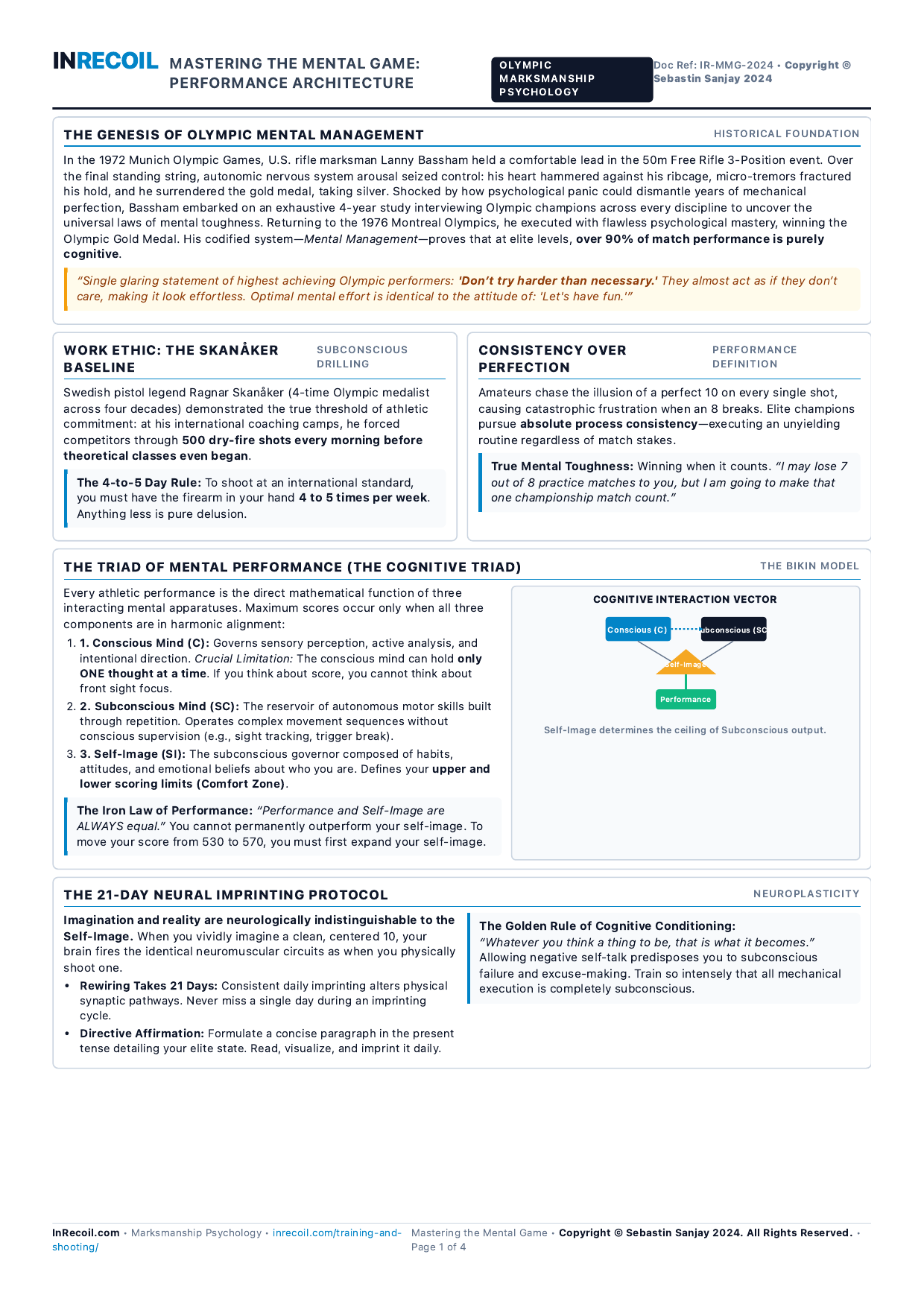
Figure 1: The InRecoil Mastering the Mental Game Manual (Copyright © Sebastin Sanjay 2024), illustrating the Triad of Mental Performance and Cognitive Interaction Vectors.
The Olympic Paradox: The Genesis of Mental Management
The doctrine of marksmanship psychology was forever altered during the 1972 Munich Olympic Games. American rifle shooter Lanny Bassham entered the final standing stage of the 50m Free Rifle 3-Position event with an insurmountable lead. As the gold medal hung in the balance, his heart rate skyrocketed, autonomic tremors gripped his hands, and conscious doubt overwhelmed his technique. He lost the gold medal by a fraction of a millimeter, taking home silver.
Devastated by how psychological collapse could nullify years of physical dedication, Bassham sought out sports psychologists—only to discover that none understood the acute pressure of firing a projectile into a ten-ring smaller than a coin. He spent the next four years interviewing Olympic champions across every discipline to isolate the common denominator of victory. What he discovered was striking: elite athletes estimate that at championship levels, over 90% of sports performance is strictly cognitive.
Bassham synthesized these findings into a unified doctrine known as Mental Management. Returning to the 1976 Montreal Olympics, he dominated under intense psychological pressure to capture the Olympic Gold Medal. The foundational takeaway of his research remains marksmanship’s ultimate paradox:
“Single glaring statement of highest achieving Olympic performers: ‘Don’t try harder than necessary.’ They almost act as if they don’t care, making it look effortless. Optimal mental effort is identical to the attitude of: ‘Let’s have fun.’”
When an athlete “tries hard” during a match, they engage the conscious, analytical cortex. In precision shooting, conscious effort introduces muscle tension, micro-hesitations, and erratic trigger presses. Peak marksmanship occurs only when conscious striving yields to automated subconscious execution.
The Foundation of Commitment: The Skanåker Baseline
Mental toughness cannot exist in a vacuum of inadequate preparation. Swedish pistol legend Ragnar Skanåker—who competed in seven consecutive Olympic Games across four decades, winning gold in Munich 1972 and multiple medals through Barcelona 1992—epitomized the work ethic required to build an unbreakable subconscious skill base.
At his international coaching clinics, Skanåker famously started every athlete with 500 dry-fire shots every single morning before theoretical lectures even began. This ruthless commitment reinforces an essential truth of competitive shooting:
The 4-to-5 Day Marksmanship Commitment Rule
To compete at a national or international standard, you must have the firearm in your hand 4 to 5 times per week. Anything less than four sessions weekly is pure delusion. Without this consistent volume, the neuromuscular pathways governing the precision pistol grip, sight alignment, and trigger break degrade, forcing the athlete to rely on conscious effort.
Furthermore, elite athletes abandon the amateur obsession with perfection. Amateurs obsess over shooting a 10 on every single shot, spiraling into frustration the moment an 8 appears. Champions pursue absolute process consistency: executing their established routine without deviation, regardless of score or match standings.
The Triad of Mental Performance: Decoding the Cognitive Machine
The core scientific breakthrough of the InRecoil mental management architecture is the Cognitive Triad: the understanding that every human action is governed by three interacting mental apparatuses:
1. The Conscious Mind (C)
The Conscious Mind governs active sensory perception, verbal analysis, and intentional command. It tells your body what to do. However, the conscious mind possesses a fatal physiological constraint:
The conscious mind can focus on only ONE thought at a time.
If your conscious mind is calculating scores, wondering about leaderboard rankings, or worrying about a previous flyer, it cannot concurrently focus on maintaining razor-sharp visual focus on the front sight. The role of the conscious mind in shooting is strictly to provide positive direction, not to micromanage physical execution.
2. The Subconscious Mind (SC)
The Subconscious Mind is the repository of all automated motor skills built through repetition. It governs complex muscular coordination without conscious intervention. When you drive a car or write your signature, your subconscious executes the task effortlessly. In shooting, the subconscious manages sight picture centering, postural balance over your feet, and the continuous linear squeeze of the trigger sear.
3. The Self-Image (SI)
The Self-Image is the master governor of athletic performance. It consists of your deeply ingrained habits, attitudes, and emotional beliefs about your identity and capability. Your self-image establishes your Performance Comfort Zone—your subconscious upper and lower limits.
For example, if an athlete’s self-image dictates: “I am a 540-point shooter who occasionally shoots 550,” their scores will inevitably oscillate between 535 and 545. If they accidentally shoot a brilliant 98 on their first two strings, their self-image sounds an internal alarm: “This is not like me!” Anxiety immediately surges, hand tremors appear, and subsequent strings drop to 88 to restore the comfort zone average.
The Iron Law of Marksmanship Psychology
Performance and Self-Image are ALWAYS Equal.
You cannot permanently outperform your self-image. Technical practice alone will never raise your scores if your self-image remains trapped at a lower tier. To permanently shoot 575+, you must first re-engineer your self-image to believe that 575+ is your natural baseline.
The 21-Day Neural Imprinting Protocol
The human brain exhibits remarkable neuroplasticity. Neurologically, the Self-Image cannot distinguish between a real physical experience and a vividly imagined sensory rehearsal. When you sit in a chair with eyes closed and vividly visualize the sights lifting, locking, and releasing a pure center-10, your motor cortex fires the exact same synaptic pathways as live-fire shooting.
Rewiring the self-image requires Imprinting: the deliberate process of feeding the subconscious with positive sensory data. Neurobiological studies demonstrate that physical synaptic remodeling requires 21 consecutive days of consistent reinforcement:
- Never Miss a Day: Missing a day resets neural reinforcement. Imprint daily for 3 consecutive weeks.
- Directive Affirmations: Formulate a concise written statement defining your target standard in the present tense.
- Feast on Success: Immediately after firing a centered 10, pause and savor the feeling. Burn the muscle memory, sight picture, and emotional sensation into your neural memory.
- Starve Failure: If you fire a 7 or 8, never react emotionally. Do not complain, pound the bench, or analyze the mistake on the line. Let the memory evaporate, mentally replace it with an image of a 10, and reset.
The Three Phases of a Task: Preserving Neural Integrity
Every single competition shot must be dissected into three distinct chronological phases:
| Phase | Cognitive Function | Shooting Range Execution |
|---|---|---|
| 1. Anticipation Phase | Preparation & Priming | Conscious mind gives clear direction to the subconscious: “We are going to shoot a 10.” Rehearsing the sensory feel of sight stability before lifting the gun. |
| 2. Action Phase | Subconscious Execution | The conscious mind remains silent, focused only on front sight sharpness. The subconscious fires the shot on a continuous rhythm without hesitation or stopping. |
| 3. Reinforcement Phase | Critical Imprinting Window | Review the shot immediately. If a 10: revel in the sensation to duplicate it. If a non-10: visualize a 10, erase the memory, and deny the opportunity for a self-fulfilling prophecy. |
The Danger of Social Sabotage
One of Bassham’s most profound psychological warnings concerns post-match social interaction. How do shooters unknowingly sabotage themselves and their peers? By asking: “How did you do?”
This innocent inquiry immediately invites athletes to vent about dropped points, fluctuating wind flags, or sticky triggers. In doing so, they recount their failures, burning those negative memories deeper into their self-image. To safeguard your competitive edge:
- Never Ask Peers for Scores: Ask instead what they executed well (e.g., “Your stance looked rock-solid today!”).
- Praise Others Generously: Tell teammates about another shooter’s success story. Because the subconscious cannot differentiate between external dialogue and self-perception, praising another athlete’s composure positively imprints your own mind.
- Ban Range Complaints: Never complain to family, friends, or club members outside your shooting circle. Complaining reinforces the very habits you wish to eliminate.
Match Strategies: Managing Adrenaline & Centering
Championship finals generate intense physiological arousal. When your heart rate exceeds 110 beats per minute, fine motor control begins to deteriorate, and holding stability suffers. Elite competitors utilize two proven bio-hacks to regain autonomic composure:
1. The “Fake Yawn” Physiological Reset
When match anxiety strikes on the firing line, execute an exaggerated, deep Fake Yawn. A yawn forces a full diaphragmatic inhalation, stretches the facial and jaw muscles, and stimulates the vagus nerve. Within 15 seconds, vagal activation releases acetylcholine, slowing the heart rate, reducing blood pressure, and eliminating acute micro-tremors.
2. The 4-Step Centering Protocol
Centering is an active distractor skill designed to rapidly break the cycle of panic following an unexpected flyer or difficult string:
- Deep Diaphragmatic Breath: Inhale slowly through your nose for 4 seconds, allowing your abdomen to push outward. Exhale smoothly through pursed lips for 6 seconds.
- Deliberate Muscular Release: Actively release tension in the four primary marksmanship stress zones: the neck, shoulders, tongue, and shooting hand. (A tense tongue indicates an overactive conscious brain).
- Re-Center Base of Support: Direct your kinesthetic attention downward into the soles of your feet. Verify that your weight is distributed 50/50 without leaning toward the toes or heels, anchoring your precision pistol stance.
- Picture a Perfect 10: Close your eyes and project a vivid mental hologram of the front sight blade sitting razor-sharp in the notch as a clean 10 breaks.
The 5-Point Olympic Pre-Shot Mental Program
You do not need to maintain intense concentration for two continuous hours. Elite marksmen understand that you only need to be mentally “UP” for 8 to 10 seconds per shot. The rest of the time on the line is spent in relaxed, passive recovery.
To ensure that those 10 seconds are impervious to distraction, every shot must be driven by an immutable 5-point mental program:
- Point of Initiation (Physical Setup): Loading the pellet or cartridge, cycling the bolt, settling the shooting hand into the grip backstrap, and establishing eye gaze downrange.
- Point of Attitude (Internal State): Recalling the somatic sensation of shooting a 10. Taking a deep breath, setting the shoulders, and adopting an attitude of effortless confidence (“Let’s have fun”).
- Point of Direction (Visual Lift): As the firearm is raised smoothly into the target area, the mind visualizes the sights descending effortlessly into the aiming area, mastering the minimum arc of movement.
- Point of Control (Environmental Check): A brief, subconscious scan of external conditions—confirming wind flags, lighting changes, and checking that the breathing pause is calm and settled.
- Point of Focus (Execution): The conscious mind narrows 100% onto a single visual anchor: the front sight blade. Subconscious motor pathways execute a smooth, positive rearward trigger press. Follow-through is maintained for one full second after discharge.
An effective mental program must be duplicable under maximum pressure, must completely occupy the conscious mind to lock out negative thoughts, and must be visual rather than verbal.
Navigating the Non-Linear Mastery Curve
Athletic progression in precision sports is never a smooth, upward linear slope. It is a wave consisting of rhythmic Ascents and inevitable Descents:
- The Ascent: Days or weeks where shooting feels effortless, holds are tight, and scores consistently hit personal bests. Rule of Repetition: When on an ascent, keep shooting! Ride the wave and log high volumes of positive reinforcement.
- The Descent: Periods where holding stability collapses, reaction times lag, and scores plummet by 10 to 15 points. Descents are a natural biological phase where the central nervous system is consolidating newly acquired motor skills.
The Fatal Amateur Trap: Changing Gear in a Descent
When amateurs encounter a performance descent, they panic. They blame their equipment, alter their grip putty, change sight apertures, adjust shoe inserts, or completely rework their stance. This destroys months of subconscious training. When in a descent, stick rigidly to your proven fundamentals. If self-doubt creeps in, switch temporarily to a trusted backup firearm and reduce session length. Never practice failure—if a training session is thoroughly unproductive, pack your range bag and walk away.
The Performance Journal: Cognitive Architecture on Paper
If you do not track your thoughts and performance, you are mathematically doomed to repeat non-peak performances. A championship shooting diary is not a score log—it is a cognitive auditing tool structured into three sections:
- The One-Person Solution Analysis: State the exact technical flaw you experienced (e.g., “I am struggling with trigger snatching on shot 7.”). Name ONE trusted coach or mentor to consult. Speak to that individual alone. Seeking advice from five different club members generates cognitive chaos and escalates anxiety.
- Success Analysis: Answer the daily question: “What did I do well today?” Documenting success forces your conscious mind to catalog positive execution, building upward pressure on your Self-Image comfort zone.
- The 3-Part Goal Statement:
- Score Statement: “I often shoot above 570.” (Phrased with “often” to establish comfort rather than rigid pressure).
- Technique Statement: “I often shoot when my sights are aligned and crystal crisp.”
- Position Statement: “I am a national-level championship competitor.” (Affirms identity and eliminates intimidation when facing reigning champions).
The 4 Behavioral Styles in Shooting Sports
Every athlete processes match stress through their innate psychological temperament. In coaching psychology, athletes fall into four behavioral quadrants based on two axes: Decisive vs. Cautious and People-Oriented vs. Self-Reliant (Task):
| Style Archetype | Defining Characteristics | Competitive Vulnerabilities | Coaching Strategy |
|---|---|---|---|
| DRIVER Decisive • Self-Reliant |
High productivity, workaholic, take-charge attitude (“I’ll handle it”). | Impatient, tactless, forces shots under stress, prone to overtraining. | Enforce mandatory rest days. Teach smooth execution rhythm rather than aggressive force. |
| EXPRESSIVE Decisive • People-Oriented |
Enthusiastic, talkative, energized by crowds, loves the excitement of finals. | Easily distracted, juggles too many projects, changes equipment and settings constantly. | Lock down firearm settings with paint markers. Implement rigid written pre-shot checklists. |
| AMIABLE Cautious • People-Oriented |
Cooperative, supportive teammate, great volunteer, seeks harmony and consensus. | Hesitant on the trigger, dislikes cutthroat competition, struggles to train alone. | Build trigger decisiveness. Foster independent confidence in solo dry-fire sessions. |
| ANALYTIC Cautious • Self-Reliant |
Methodical, meticulous, persistent, records extensive ballistic and SCATT data. | Perfection paralysis, over-analyzes sight wobble, terrified of shooting bad shots. | Teach acceptance of movement area. Emphasize continuous rhythm over static alignment. |
Crucial Coaching Rule: Never attempt to change an athlete’s behavioral style. A perceived weakness is merely an unguided asset. Help each shooter understand their style, harness its natural strengths, and build safeguards against its blind spots.
Directive Affirmations: Rewiring the Self-Image
To upgrade your self-image, you must utilize Directive Affirmations. An effective affirmation is a short, commanding paragraph defining the exact cognitive and behavioral habits you choose to embody.
The cardinal rule of affirmation syntax is the Past/Present Grammar Formula:
Address past challenges strictly in the PAST tense; affirm current reality in the PRESENT tense.
Sample Directive Affirmation
“In the past, I struggled with rushing my trigger break whenever the countdown clock ran low. Now, I maintain unbroken composure, trust my subconscious hold, and release clean, centered 10s with absolute confidence under match pressure.”
The 5-Copy Distribution Protocol
- Write your directive affirmation on 5 index cards or sticky notes.
- Place them in high-visibility daily locations away from the shooting range: on your bathroom mirror, your car steering wheel, your computer monitor, your bedside table, and inside your range bag.
- Whenever your eyes meet a card: Stop, read the words aloud, and spend 10 seconds visualizing yourself executing that behavior.
- Run only ONE affirmation at a time for 21 consecutive days. Changing more than one habit per month dilutes neuroplastic adaptation.
Building Total Life Control: The 6 Pillars of Excellence
Championship performance cannot be achieved if chaos rules your life outside the range. Elite marksmanship demands total conscious sovereignty across six life domains:
- 1. Thought Control: Zero tolerance for self-pity, excuses, or defeatist mental chatter.
- 2. Nutritional Control: Fueling for cognitive endurance. High-glycemic fruits provide immediate glucose without digestive energy drain. Heavy fats and processed meals before matches divert blood flow to digestion, slowing reaction time.
- 3. Linguistic Control: Absolute discipline over what you say. Never speak words that contradict your desired self-image.
- 4. Temporal Control: Ruthless time management. Schedule training sessions as inviolable calendar commitments.
- 5. Social Control: Surrounding yourself exclusively with shooters who are technically superior, positive, and driven. Distance yourself from chronic complainers.
- 6. Media Control: Strictly filtering your digital consumption prior to major competitions to preserve mental serenity.
[row]
[column width=”6″]
Core Technical Shooting Guides
Reinforce your mental game with fundamental mechanics guides:
[/column]
[column width=”6″]
Diagnostic & Planning Resources
Complement mental training with diagnostic and periodization manuals:
[/column]
[/row]
The Four Keys to Marksmanship Success
Achieving mastery in shooting sports rests on four essential forms of capital:
- Time: The non-negotiable dedication of holding a firearm 4 to 5 days every week.
- Money: Investing in quality ammunition, precision equipment, travel, and tournament entries.
- Effort: The willingness to push through hundreds of dry-fire repetitions when motivation wanes.
- People (Mentorship): The hardest and most critical asset to acquire. No shooter reaches the Olympic podium alone. Find a mentor, follow their instruction without debate, protect their trust, and reward them for guiding your success.
[box]
Print the InRecoil Mastering the Mental Game Manual (PDF)
Download the high-resolution, 4-page A4 vector coaching document. Designed for range bags, coach briefings, and daily visualization desks. Includes complete graphic diagrams, tables, and affirmation templates.
[button url=”https://inrecoil.com/wp-content/uploads/2026/11/inrecoil-mastering-the-mental-game.pdf” text=”Download Free Mental Game PDF”] [button url=”https://inrecoil.com/training-and-shooting/training-overview/” text=”Explore Complete Training Hub”]
[/box]
Have questions regarding mental management, visualization routines, or competitive anxiety? Connect with our coaching specialists on our About InRecoil page or submit a question through our Contact Page.