

In Olympic and international marksmanship, the difference between an amateur hobbyist and a podium contender is not talent—it is the quality of their performance auditing. Thousands of shooters fire tens of thousands of rounds every year without making measurable progress. They leave the range with a vague emotional impression: either feeling delighted by a lucky string or frustrated by an unexpected flyer. Because they never capture the underlying physiological, psychological, and biomechanical parameters of their session, they are condemned to repeat their mistakes indefinitely. At InRecoil, we are proud to publish the official Precision Shooting Diary & Performance Analysis Matrix, authored by Sebastin Sanjay (Copyright © Sebastin Sanjay 2024), available as a high-resolution 2-page downloadable vector PDF reference workbook.
[box]
Download the Official Precision Shooting Diary & Performance Analysis Manual (PDF)
Equip your range kit with the complete 2-page printable coaching workbook designed exclusively for InRecoil. Features comprehensive session biometric tracking, 10-point psychometric readiness sliders, 60-shot qualification scoring tables, 6 vector target group plotters, the One-Person Solution protocol, and the 3-tier forward goal architecture.
[button url=”https://inrecoil.com/wp-content/uploads/2026/11/inrecoil-shooting-diary-performance-analysis.pdf” text=”Download Free Shooting Diary (PDF)”] [button url=”https://inrecoil.com/training-and-shooting/training-overview/” text=”Explore Training Architecture Hub”]
[/box]
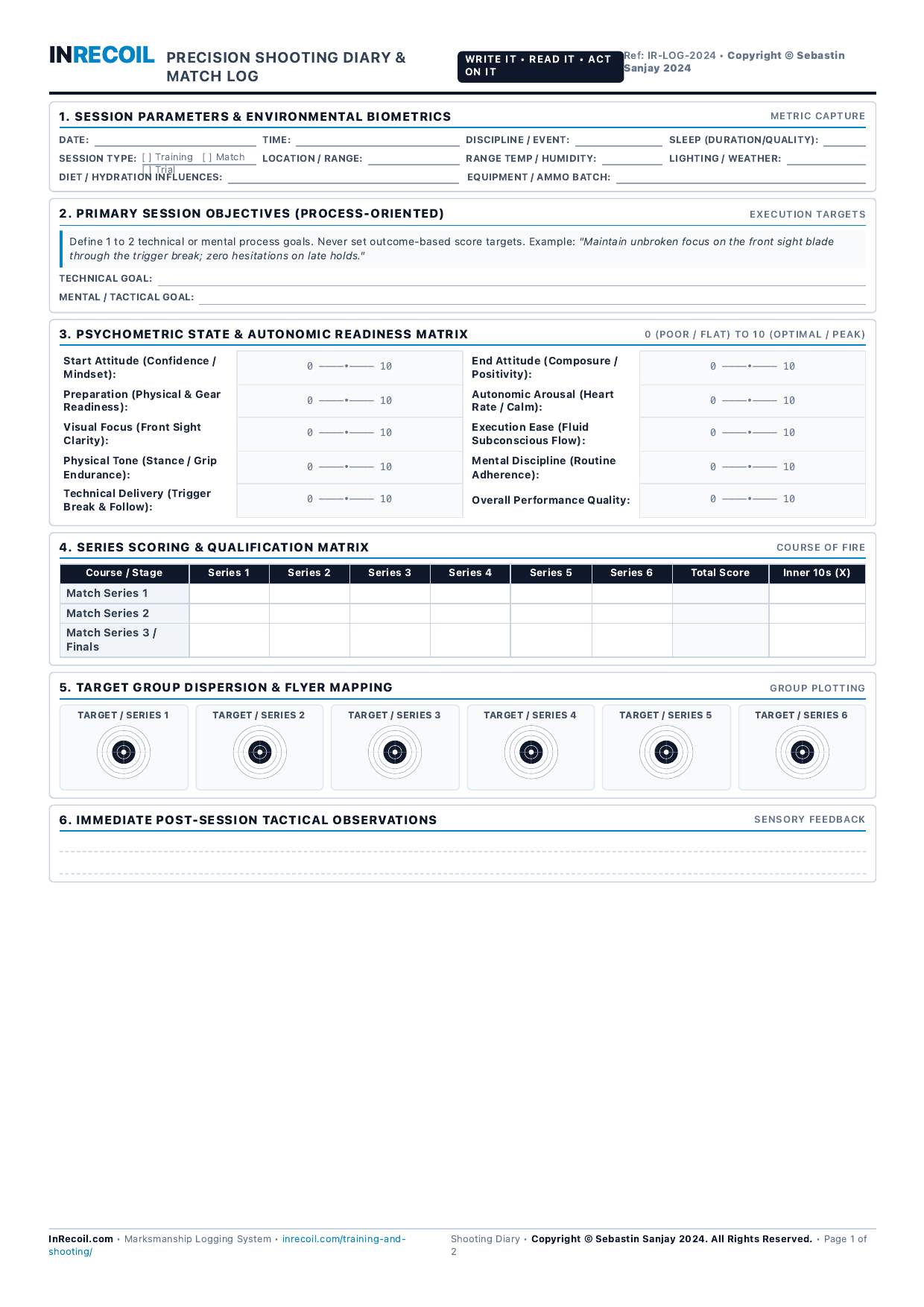
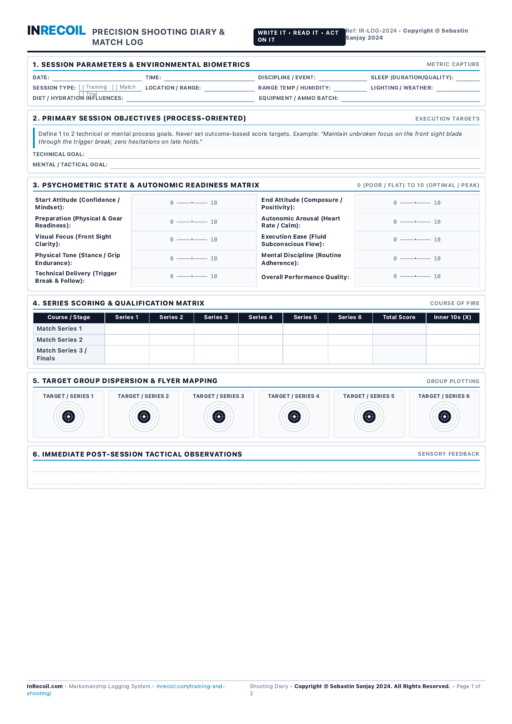
Figure 1: The InRecoil Precision Shooting Diary & Performance Analysis Log (Copyright © Sebastin Sanjay 2024), illustrating session parameters, dual-state psychometric scales, and group dispersion plotters.
The Cardinal Rule: If You Don’t Write It Down, It Didn’t Happen
The human brain is notoriously unreliable at recalling physical sensations. After an intense 90-minute competition string, sensory memory degrades rapidly. Within two hours, an athlete cannot accurately recall whether their 7 at 8 o’clock was caused by a late respiratory pause, a lapse in front sight focus, an involuntary flinch, or excessive thumb clamp. As Olympic sports psychology teaches: “Write It, Read It, Act On It!”
A shooting journal is not a mere score log. Logging only your total score (e.g., “shot 562 today”) is completely useless. A score is an outcome; it tells you nothing about the process delivery that produced that score. A true precision shooting journal serves three critical functions:
- Cognitive Auditing: Isolates the root cause of mechanical flaws while preventing emotional overreaction.
- Self-Image Imprinting: Systematically documents technical success to rewire the subconscious comfort zone.
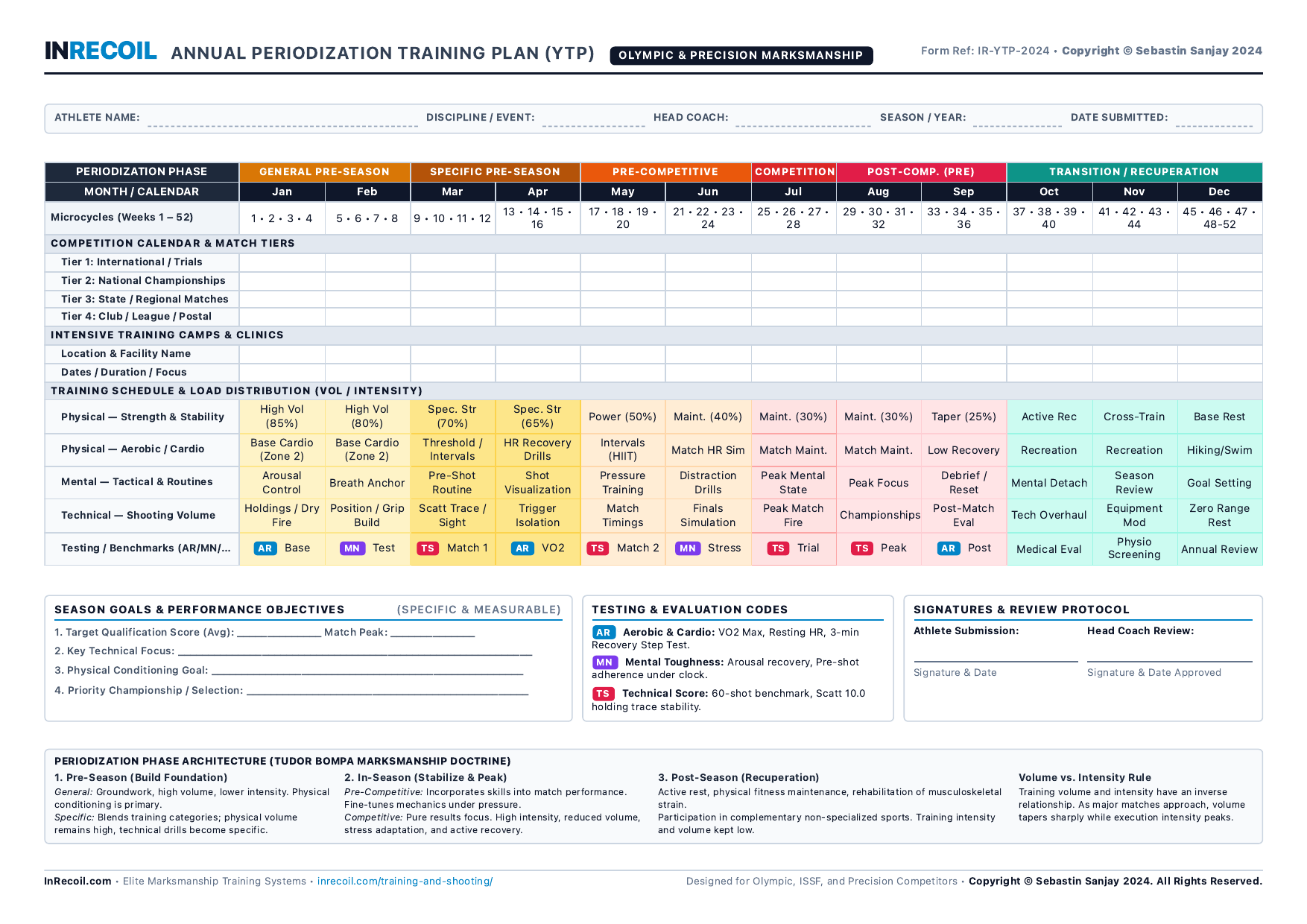
- Data-Driven Periodization: Tracks fatigue, sleep, nutrition, and environmental trends to guide your Annual Periodization Training Plan (YTP).
Anatomy of the InRecoil Shooting Diary (Page 1 Breakdown)
The first page of our newly redesigned system is dedicated to capturing objective real-time data immediately before, during, and after your shooting session:
1. Session Context & Biometric Factors
Marksmanship performance is intimately tied to internal physiology and external physics. Our log sheet captures eight critical variables:
- Date, Time & Event: 10m Air Pistol, 25m Rapid Fire, 50m Free Pistol, or Smallbore Rifle.
- Session Classification: Distinguishing between fundamental technical training, SCATT optoelectronic drills, pressure simulations, and formal match trials.
- Sleep Duration & Quality: Neurological holding stability begins in the bedroom. Less than 7 hours of restorative sleep directly degrades fine motor control and expands your minimum arc of movement.
- Nutritional & Hydration Influences: Logging caffeine intake, hydration levels, and pre-match meals. High-fat meals divert blood to digestion, inducing sluggishness, while excess caffeine elevates resting tremors.
- Range Environmental Metrics: Ambient temperature, humidity, and lighting intensity. As established in our Essentials of Pistol Sighting Guide, fluctuating range lighting shifts your perceived sight picture and point of impact.
2. Process-Oriented Session Objectives
Before unzipping your pistol case, you must define 1 to 2 process-oriented goals. Never write an outcome goal like “shoot a 575.” Outcome goals induce anticipatory anxiety. Instead, write executable mechanical commands:
- “Execute a positive, uninterrupted trigger press straight rearward on every shot.”
- “Lock visual accommodation strictly onto the front sight blade through the full 1.0 second of follow-through.”
3. Dual-State Psychometric & Autonomic Scales (0 to 10)
A unique breakthrough of the InRecoil system is the dual-state psychometric slider matrix. By rating yourself on a 0 (poor/flat) to 10 (peak/optimal) scale across five core psychological and physical axes, you map your internal arousal curve:
| Psychometric Dimension | Pre-Session Rating Metric | Post-Session Rating Metric |
|---|---|---|
| Attitude & Mindset | Start Attitude: Initial confidence, enthusiasm, and competitive eagerness. | End Attitude: Composure, emotional stability, and constructive perspective post-match. |
| Arousal & Readiness | Preparation: Thoroughness of physical warmup, gear check, and dry-fire holding. | Autonomic Arousal: Ability to control heart rate, anxiety, and tremors under match clock. |
| Focus vs. Flow | Visual Concentration: Sharpness of front sight focus; blocking out distractions. | Execution Ease: Freedom from conscious micromanagement; smooth subconscious rhythm. |
| Physical vs. Mental | Physical Tone: Muscular endurance in shoulder stabilizers, core, and grip pressure. | Mental Discipline: Adherence to the 5-point pre-shot routine across all 60 shots. |
| Technical vs. Overall | Technical Delivery: Clean sear release, minimal trigger snatch, solid follow-through. | Overall Match Quality: Holistic evaluation of execution integrity regardless of score. |
4. Series Scoring & Target Group Dispersion Plotting
The lower half of Page 1 features an official 6-series x 10-shot scoring grid alongside six high-resolution vector target plotters. Rather than just recording a total score, athletes physically plot their shot impact coordinates for each series:
- Core Cluster Identification: Identify the tight 80% ellipse where your well-executed shots landed.
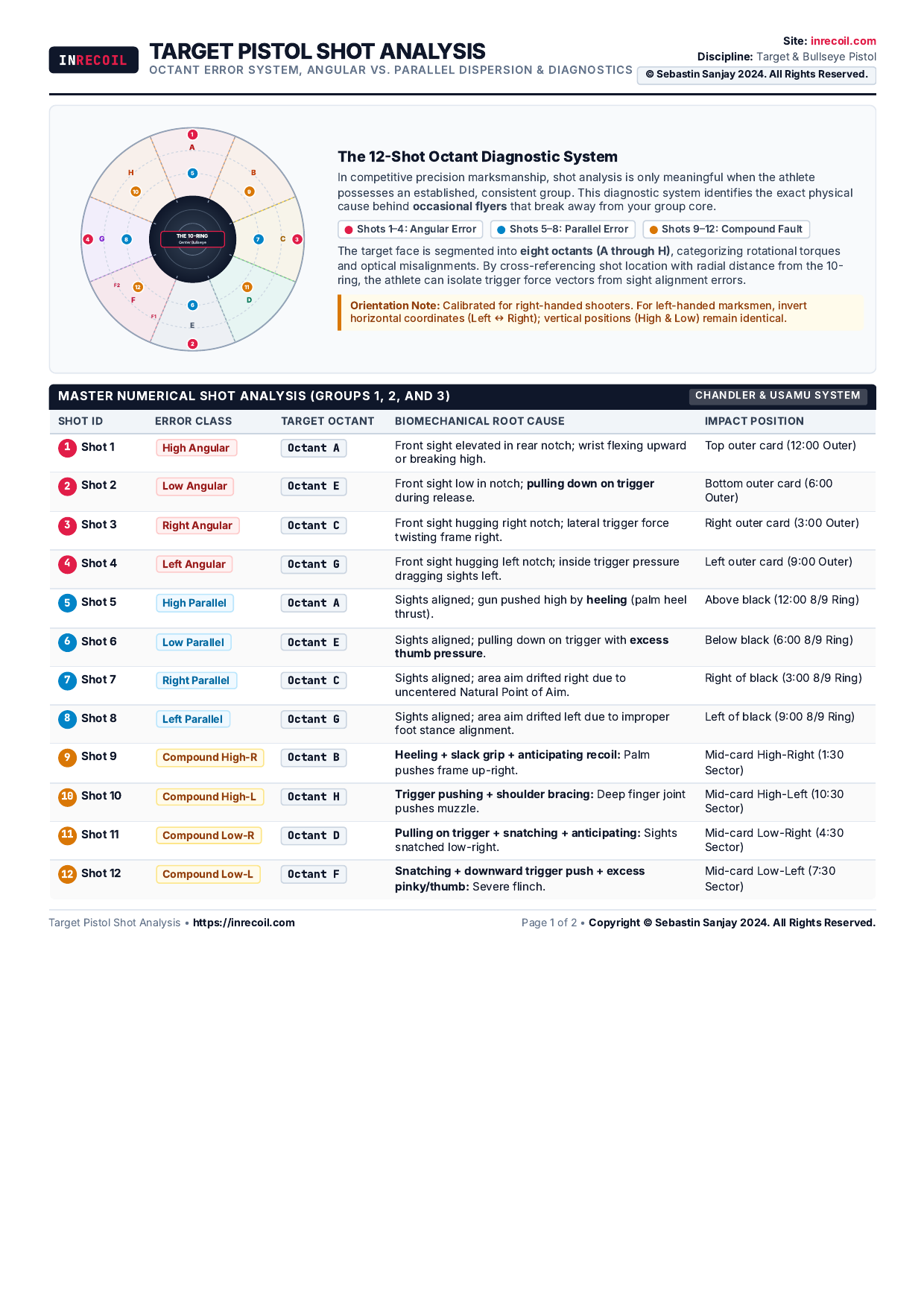
- Flyer Isolation: Draw an arrow to any outlier shot and cross-reference its geometric coordinates against our Target Pistol Shot Analysis Manual to diagnose whether the fault was angular (outer white rings) or parallel (inner black rings).
- Zeroing Verification: Determine if your group center has drifted due to canting, head tilt, or changing range illumination.
The Performance Analysis Architecture (Page 2 Breakdown)
While Page 1 captures the raw facts of the session, Page 2 is where athletic transformation occurs. Rooted in the principles of Olympic Mental Management, this page rewires your cognitive self-image:
1. Solution Analysis & The One-Person Rule
When an athlete shoots poorly, their immediate instinct is to complain to everyone in the clubhouse. They ask five different club members for advice, receiving five conflicting opinions: “Change your grip!” “Lighten your trigger!” “Move your feet!” “Change your glasses!” The result is complete cognitive overload and catastrophic self-doubt.
The One-Person Solution Protocol
Under the InRecoil protocol, you define your specific issue in precise technical terms (e.g., “I am snatching the trigger low-left on the 8th and 9th shots of sustained strings”). You then name ONE qualified coach or mentor. You consult that individual and that individual alone. You record the root biomechanical diagnosis and the prescribed remedial drill. You never solicit unsolicited range opinions.
2. Success Analysis: Rewiring the Subconscious Comfort Zone
The human brain is evolutionarily wired with a negative bias—we obsess over what went wrong. A shooter who fires fifty-six 10s and four 8s will spend the entire drive home cursing the 8s. In doing so, they recount the sensations of the bad shots, burning those flawed motor patterns deeper into their neural pathways.
Our Success Analysis forces a neurobiological reset by asking: “What did I do exceptionally well today?”
- You must document at least three specific technical successes from the session (e.g., “Aborted three delayed holds calmly; executed an unbroken follow-through on series 4; kept visual focus locked on the front sight blade during finals pressure”).
- By celebrating and recording your 10s, you feed your subconscious mind with high-value positive sensory data. This raises your internal Self-Image Comfort Zone, making high scores feel natural and expected.
3. The 3-Tier Forward Goal Architecture
Amateur goals are vague and pressure-inducing (“I want to shoot 580 next week”). Championship goal-setting is linguistic and structured into three distinct psychological dimensions:
The Three Essential Goal Statements
- A. Score Comfort Statement: “I often shoot above 570.”
Notice the critical inclusion of the word “often”. Stating “I must shoot 570” creates performance anxiety; stating “I often shoot above 570” affirms to your subconscious that 570 is within your natural capability. - B. Technique Execution Statement: “I often shoot when my sights are aligned and crystal crisp.”
Anchors your execution to the visual reality of front sight focus rather than outcome pressure. - C. Position & Identity Statement: “I am a national-level championship competitor who belongs on the podium.”
Reminds you of your athletic identity, eliminating the subconscious intimidation that amateur shooters feel when standing on the line next to reigning champions.
The Four Dangerous Journaling Traps That Sabotage Marksmen
While an accurate shooting journal is an indispensable weapon in a champion’s arsenal, improper journaling can be actively toxic. If an athlete approaches their diary with the wrong psychological framing, the notebook becomes a repository of self-fulfilling negative prophecies. Beware of these four pervasive traps:
1. The Outcome Obsession Trap (The “Scorekeeper’s Disease”)
The most common failure mode is treating your shooting diary as an accounting ledger. Shooters write: “Shot a 554 today. Dropped four 8s in series three. Felt terrible.” This entry provides zero diagnostic value. Numbers on a scoreboard are byproducts of bio-mechanical execution. If your journal fails to record front sight clarity, grip pressure consistency, trigger break timing, and respiratory pause discipline, you are measuring outcomes while ignoring the mechanisms that create them.
2. The Emotional Venting Trap
Never use your shooting diary as an emotional dumping ground. Writing paragraphs lamenting how “the range officers were loud, my trigger felt mushy, and I choked on the last string” serves only to burn the emotional and physical memory of failure deeper into your subconscious mind. Your Self-Image cannot distinguish between an actual event and a written recount. Every time you re-read an emotional rant, you reactivate the neural pathways of that bad match. Document technical problems objectively in the Solution Analysis, and leave emotional tantrums off the page.
3. The Passive Collector Trap (The “Unread Journal”)
Writing in a journal without ever reviewing it is like shooting at a target and never looking through your spotting scope. The true power of the InRecoil system lies in periodic auditing. Every Sunday evening, or at the conclusion of every 4-week mesocycle, athletes must cross-reference their logs:
- Are your scores consistently dipping in Series 5 and 6? That points directly to physical stamina deficits or ocular accommodation fatigue.
- Are low-left flyers appearing primarily on days with less than 6.5 hours of sleep? That reveals a direct link between neurological exhaustion and sympathetic finger snatching.
- Are your highest scores correlated with specific pre-competition meals or hydration routines?
4. The Multivariable Chaos Trap
When athletes hit a performance plateau, their natural impatience drives them to alter four things at once: adjusting the grip angle, modifying shoe orthotics, changing ammunition batches, and altering their stance. When their score shifts by five points the next day, they have no idea which variable produced the change. The shooting diary enforces scientific discipline: test ONE variable at a time across a minimum of three logged sessions before drawing conclusions.
Quarterly Coach-Athlete Auditing: Transforming Logs into Podiums
In high-performance training centers, the shooting diary serves as the official legal document of athlete development. During quarterly coach-athlete reviews, coaches do not ask: “How have you been feeling?” They open the athlete’s InRecoil diary and examine three empirical trends:
- The Arousal-to-Score Correlation: By plotting the athlete’s 0-to-10 Autonomic Arousal ratings against series scores, coaches identify the athlete’s unique Individual Zone of Optimal Functioning (IZOF). Some shooters perform best at an arousal level of 4 (calm and relaxed), while others thrive at a 7 (energized and aggressive). Knowing your exact number eliminates match-day guesswork.
- Target Group Center-of-Mass Drift: By analyzing the six vector target plotters across twenty logged sessions, coaches can detect subtle seasonal shifts in Natural Point of Aim (NPA), foot pressure migration, or grip deterioration that the naked eye cannot spot on a single target.
- Self-Image Comfort Zone Evolution: Coaches inspect the 3-tier goal statements to verify that the athlete’s subconscious comfort threshold is systematically moving upward in harmony with their Annual Periodization Training Plan.
How to Integrate the Shooting Diary with Your Technical Drills
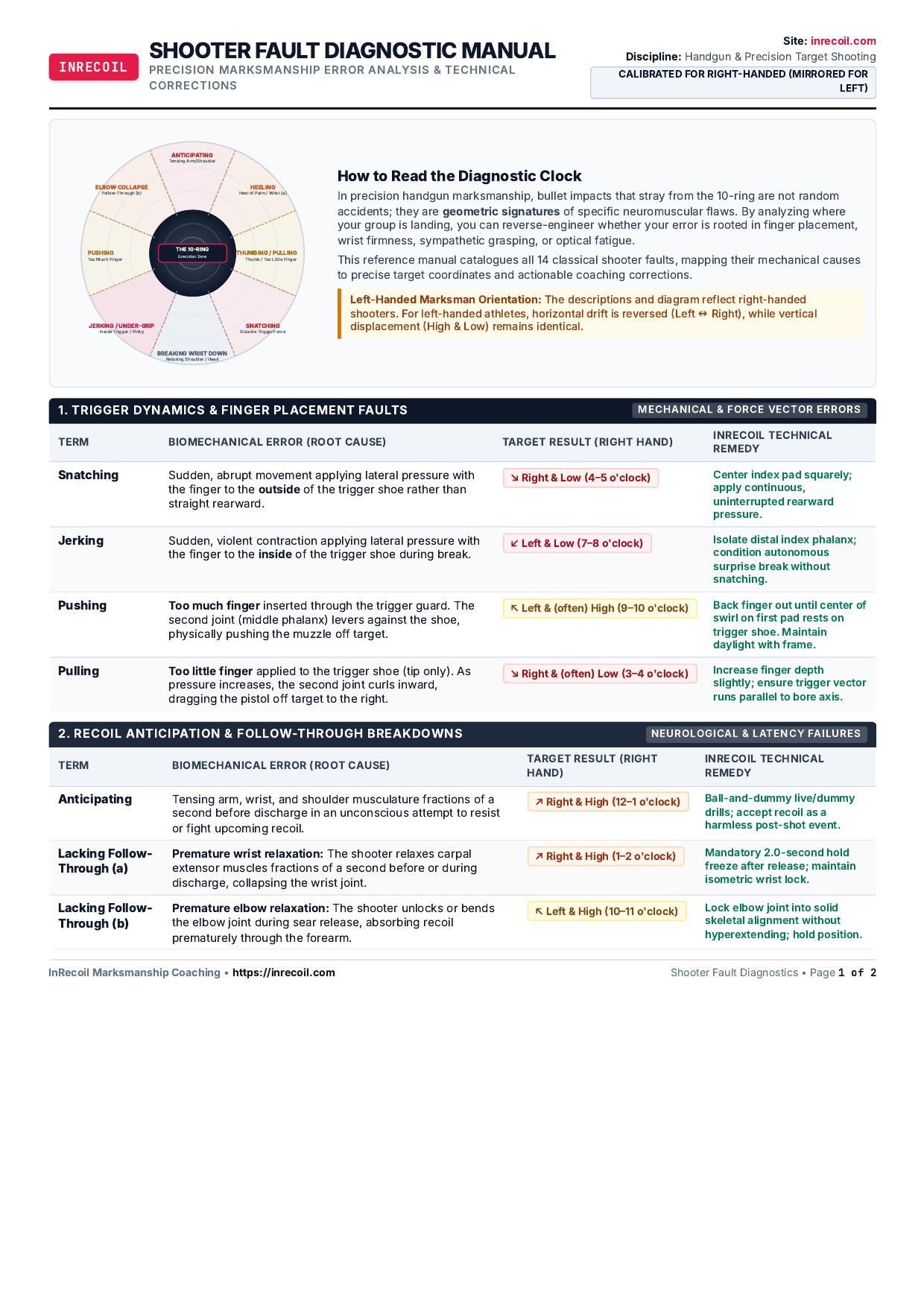
A shooting diary is an operational bridge connecting your training sessions to the broader InRecoil marksmanship library. When your diary identifies a specific breakdown, deploy the corresponding technical protocol:
[row]
[column width=”6″]
Biomechanical & Sighting Guides
Address physical and optical flaws diagnosed in your journal:
[/column]
[column width=”6″]
Diagnostic & Mental Guides
Correct erratic flyers and build mental resilience:
[/column]
[/row]
Step-by-Step Range Protocol: Executing the Diary System
To extract maximum value from the InRecoil Shooting Diary, follow this four-phase operational protocol for every range session:
- Pre-Session Priming (5 Minutes Before Shooting): Complete Section 1 (Date, Event, Sleep, Environmental Metrics). Define your 1 to 2 process objectives in Section 2. Complete your Pre-Session psychometric ratings (Start Attitude, Preparation, Focus).
- Live Series Recording (During the Match): Record your series scores in Section 4. Plot shot groups on the vector target diagrams in Section 5. Note any erratic flyers immediately while the physical sensation is fresh.
- Immediate Post-Session Debrief (Within 10 Minutes of Cease-Fire): Complete your Post-Session psychometric ratings (End Attitude, Arousal, Ease, Overall Quality). Record brief sensory observations in Section 6.
- Cognitive Auditing & Goal Architecture (Evening Review): Open Page 2 away from the range. Execute your Solution Analysis using the One-Person Rule. Complete your Success Analysis by logging at least three things you executed well. Formulate your 3-tier forward goal statements for the next session.
[box]
Print the InRecoil Shooting Diary & Performance Analysis Manual (PDF)
Download the high-resolution, 2-page A4 vector workbook. Print multiple double-sided copies to assemble your personal master marksmanship binder. Features clean typography, metric fields, psychometric rating sliders, and vector target plotting grids.
[button url=”https://inrecoil.com/wp-content/uploads/2026/11/inrecoil-shooting-diary-performance-analysis.pdf” text=”Download Free Shooting Diary PDF”] [button url=”https://inrecoil.com/training-and-shooting/training-overview/” text=”Explore Complete Training Hub”]
[/box]
Have questions regarding shooting journal analysis, performance plateau diagnostics, or coach-athlete logging workflows? Reach out to our coaching staff on our About InRecoil page or submit an inquiry through our Contact Page.