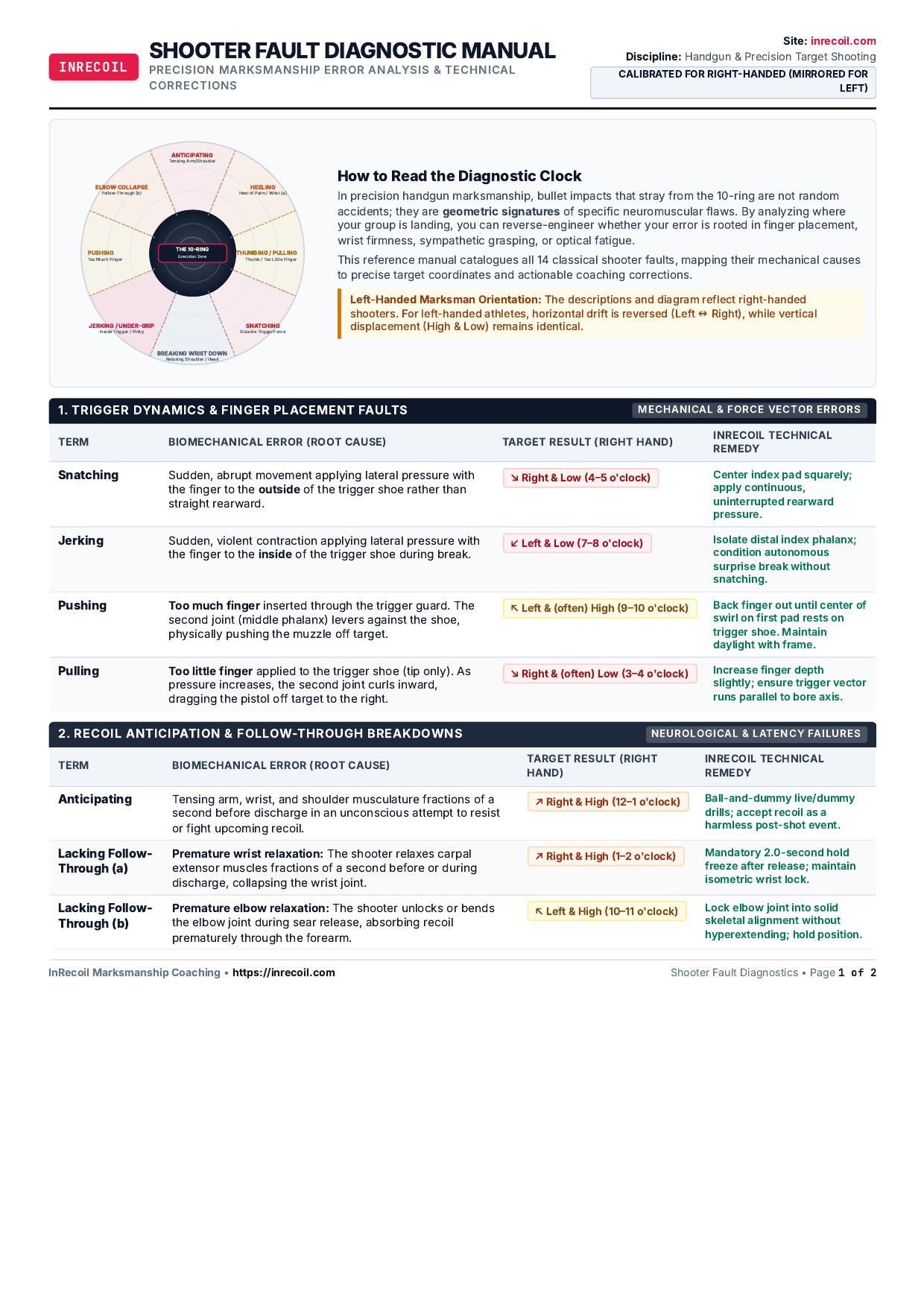


In Olympic and international shooting sports, podium finishes are never built on arbitrary range sessions—they are engineered through systematic periodization. The prevailing amateur intuition in marksmanship is simply to “shoot more rounds,” believing that repetition alone guarantees progression. In reality, the neuromuscular system cannot sustain high-volume, high-stress shooting indefinitely. Without a structured macrocycle, marksmen inevitably encounter autonomic burnout, sight-wobble deterioration, and performance plateaus right when championship trials arrive. At InRecoil, we are proud to publish the official Annual Periodization Training Plan (YTP) by Sebastin Sanjay (Copyright © Sebastin Sanjay 2024), available as a high-resolution, printable PDF coaching matrix.
[box]
Download the Official Annual Periodization Training Plan (YTP) (PDF)
Equip your season with the complete 2-page Olympic-standard coaching matrix designed exclusively for InRecoil. Features the 52-week microcycle planner, color-coded training category distribution (Physical, Aerobic, Mental, Technical), inverse volume-intensity curves, and standardized testing benchmarks (AR, MN, TS).
[button url=”https://inrecoil.com/wp-content/uploads/2026/11/inrecoil-annual-periodization-plan.pdf” text=”Download Free Periodization Plan (PDF)”] [button url=”https://inrecoil.com/training-and-shooting/training-overview/” text=”Explore Training Architecture Hub”]
[/box]
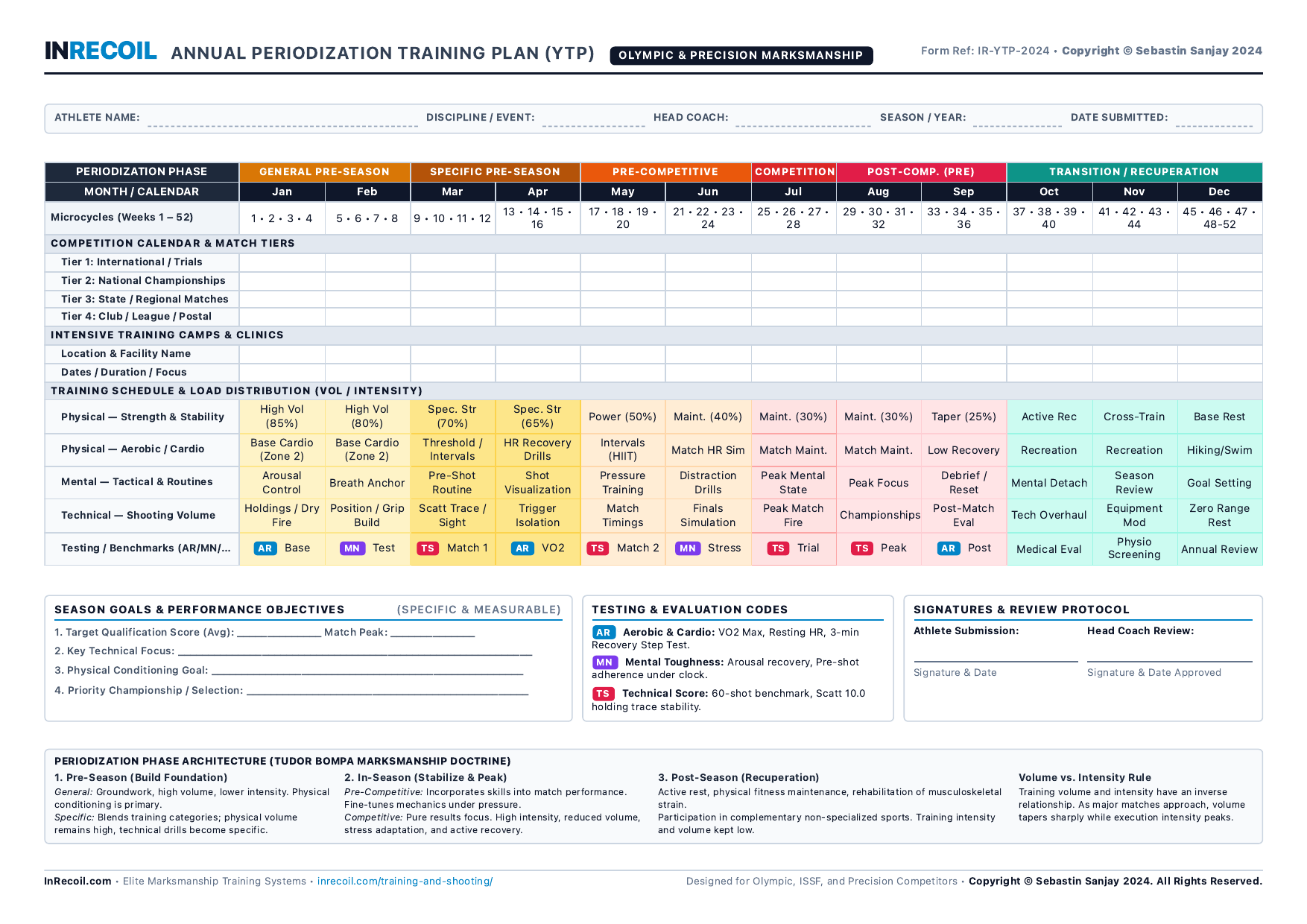
Figure 1: The InRecoil Annual Periodization Training Plan (YTP) Master Matrix (Copyright © Sebastin Sanjay 2024), illustrating the 12-month calendar, 52 microcycles, competition tiers, and training load distribution.
The Science of Periodization: Why Linear Training Fails in Target Shooting
Modern sports science owes the concept of periodization to Romanian sports scientist Tudor Bompa and Soviet sports physiologist Lev Matveyev. Their research proved that an athlete’s physiological and psychological capacity develops through cyclical phases of stress, recovery, and adaptation—a biological phenomenon known as General Adaptation Syndrome (GAS).
In explosive or endurance sports like sprinting or rowing, the necessity of periodization is readily apparent: an athlete who sprints at 100% capacity every day will tear a hamstring within weeks. In precision shooting sports—including 10m Air Pistol, 10m Air Rifle, 25m Rapid Fire Pistol, 50m 3-Position Rifle, and ISSF Clay disciplines—the physical trauma is less visible, but the neurological wear is equally severe. Precision shooting requires:
- Isometric Postural Stability: Deep tonic muscle fibers in the spine, hips, and shoulders must contract statically for hours without micro-tremors, demanding immense physical endurance.
- Autonomic Nervous System Regulation: The shooter must intentionally depress sympathetic arousal (fight-or-flight) and elevate parasympathetic tone to slow their heart rate between shots.
- Ocular Accommodation: The ciliary muscles of the eye undergo intense strain maintaining razor-sharp optical focus on the front sight blade or reticle.
- Subconscious Motor Execution: Trigger finger isolation requires pristine neuromuscular pathways free from cortical interference or sympathetic hand clamping.
When an athlete trains with static, unvaried volume across the entire calendar year, the brain adapts by blunting sensory feedback. The shooter develops “range staleness”—the holding area expands, reaction time slows, trigger release becomes hesitant, and mental fatigue ruins competition finals. The only proven solution is an Annual Training Plan (Yearly Training Plan – YTP) that systematically modulates training volume and intensity.
The Periodization Hierarchy: Macrocycles, Mesocycles, and Microcycles
To implement an effective shooting season, training must be structured into three distinct temporal tiers:
- The Macrocycle (The Annual Year): The overarching 52-week calendar leading to the primary competitive goal of the season (such as the Olympic Trials, National Championships, or World Cup Final). The macrocycle ensures that all physical, technical, and tactical capabilities peak simultaneously on match day.
- The Mesocycle (Monthly / Multi-Week Blocks): Specialized training blocks lasting from two to six weeks. Each mesocycle focuses on a singular developmental objective—such as building an aerobic cardiovascular base, refining the biomechanics of the pistol grip, or simulating elimination finals pressure.
- The Microcycle (Weekly Training Structure): A single 7-day training week consisting of individual training sessions, recovery days, and evaluation checkpoints. The microcycle balances heavy load days with planned low-intensity regeneration sessions.
The Five Periodization Phases of the InRecoil Master Matrix
The InRecoil Annual Periodization Matrix segments the 12-month shooting year into five distinct, color-coded developmental phases:
1. General Pre-Season (Months 1 – 2: Jan – Feb) — Warm Amber Phase
The primary objective of the General Pre-Season is to establish a rock-solid physiological and kinesthetic groundwork. In this phase, training volume is high (85% to 100%), while competitive intensity remains low (30% to 50%). Key focal areas include:
- Extensive Physical Conditioning: Developing core stability, rotator cuff endurance, and scapular stabilization. Athletes build the muscular endurance required to support firearm weight without postural breakdown.
- Zone 2 Cardiovascular Base: Moderate aerobic running, cycling, or rowing to expand stroke volume and lower resting heart rate (RHR), directly enhancing breath control and respiratory pause stability.
- Technical Groundwork: Dry-fire holding drills, stance alignment without target marks, and kinesthetic position awareness. Shooting scores are completely ignored during this phase.
2. Specific Pre-Season (Months 3 – 4: Mar – Apr) — Deep Ochre / Gold Phase
The Specific Pre-Season transitions base physical fitness into specific marksmanship skills. Training volume begins a subtle descent (70% to 85%), while intensity climbs (50% to 70%):
- SCATT Optoelectronic Diagnostics: Analyzing holding trace speed, aiming trajectory, and trace length inside the 10.0 ring. Athletes work directly to master their minimum arc of movement.
- Trigger Resistance & Squeeze Isolation: Eliminating sympathetic contractions in the lower fingers and thumb through blank-target trigger release drills.
- Position Refinement: Micro-adjustments to foot angle, balance distribution, and natural point of aim (NPA) to ensure the gun returns automatically to center without muscular steering.
3. Pre-Competitive Phase (Months 5 – 6: May – Jun) — Vivid Orange Phase
In the Pre-Competitive Phase, isolated skills are synthesized into match-ready execution under simulated tournament stress. Volume drops to 50%–70%, while intensity rises to 70%–85%:
- Paced Match Timings: Shooting full 60-shot qualification courses strictly against the competition clock to build consistent shot pacing and tempo.
- Pressure Simulation & Shoot-Offs: Implementing match finals training drills, single-shot eliminations, command shooting, and simulated distractions to condition autonomic arousal.
- Accepting Normal Fluctuations: Athletes must recognize that performance scores may fluctuate during this phase as mechanical adjustments adapt to psychological pressure.
4. Competitive Phase & Peaking (Months 7 – 9: Jul – Sep) — Crimson / High-Intensity Phase
The Competitive Phase is dedicated to maximum performance delivery at Tier 1 and Tier 2 championships. Here, training volume tapers sharply to 30%–50%, while psychological and technical intensity peaks at 85%–100%:
- Tapering for Supercompensation: Reducing total round count and physical gym loading by 40%–50% in the 10 to 14 days preceding major selection trials, allowing the central nervous system to achieve peak sharpness.
- Unshakable Routine Adherence: Every shot is governed strictly by the shooter’s subconscious pre-shot routine and visual focal discipline. Zero technical overhauls are permitted during this phase.
- Active Regeneration: Incorporating contrast showers, light mobility, mindfulness meditation, and sleep optimization to recover from high-stress competition weekends.
5. Transition & Recuperation (Months 10 – 12: Oct – Dec) — Teal / Active Recovery Phase
The post-season phase is vital for sustained longevity. Without a structured transition, chronic overuse injuries (such as lateral epicondylitis or cervical spine compression) and mental burnout become inevitable:
- Active Musculoskeletal Recovery: Engaging in complementary non-specialized sports (swimming, hiking, badminton) to restore muscle symmetry and relieve unilateral marksmanship strain.
- Physical Therapy & Rehabilitation: Treating lingering shoulder impingements, tendon inflammation, or postural imbalances.
- Annual Season Audit: Systematically reviewing match logs, SCATT databases, and diagnostic error patterns using our companion Shooter Fault Diagnostic Manual and Target Pistol Shot Analysis Manual.
- Equipment Overhaul: Replacing worn springs, servicing regulators, testing pellet batches, and setting measurable goals for the upcoming season.
The Inverse Volume-Intensity Law: The Biomechanics of Peaking
The foundational principle governing the InRecoil periodization model is the Inverse Law of Volume and Intensity:
The Mathematical Principle of Peak Performance
Training Volume (Quantity) and Training Intensity (Stress / Mental Quality) cannot be maintained at high levels simultaneously without precipitating systemic neurological overtraining. As competitive intensity climbs toward 100%, total shot volume must drop in inverse proportion.
When an athlete fires 150 shots in a single training session during the competitive phase, physical fatigue degrades sight stability after the 80th shot. Firing subsequent rounds while fatigued reinforces faulty motor patterns—such as snatching the trigger or collapsing the wrist at the break. Championship peaking is achieved by shooting fewer, higher-quality shots under pristine mental conditions.
| Periodization Phase | Volume (% Max) | Intensity (% Max) | Training Category Allocation | Primary Coaching Objective |
|---|---|---|---|---|
| General Pre-Season | 85% – 100% | 30% – 50% | 50% Physical • 35% Technical • 15% Mental | Aerobic groundwork, core stability, dry-fire holding volume. |
| Specific Pre-Season | 70% – 85% | 50% – 70% | 30% Physical • 50% Technical • 20% Mental | SCATT holding trace stability, trigger break mechanics, NPA. |
| Pre-Competitive | 50% – 70% | 70% – 85% | 20% Physical • 50% Technical • 30% Mental | Match pacing, finals shoot-off simulation, stress conditioning. |
| Competitive Peak | 30% – 50% | 85% – 100% | 15% Physical • 45% Technical • 40% Mental | Tapering, maximum performance delivery, psychological routine. |
| Transition / Rest | 15% – 25% | 15% – 25% | 60% Physical • 10% Technical • 30% Mental | Musculoskeletal rehab, cross-training, mental detachment. |
Standardized Testing & Diagnostic Evaluation Protocols
Periodization requires objective feedback to confirm that training adaptations are taking place. The InRecoil YTP incorporates three standardized diagnostic evaluation codes across the calendar:
1. AR: Aerobic & Cardiovascular Conditioning Assessment
A shooter’s resting heart rate and aerobic recovery directly determine how calm their body remains under match adrenaline. The AR protocol measures:
- Resting Heart Rate (RHR): Evaluated each morning upon waking. An elevation of 5 to 7 beats per minute above baseline signals autonomic nervous system overtraining or acute illness.
- 3-Minute Step Recovery Test: The athlete performs 3 minutes of rhythmic stepping, measuring how rapidly their pulse drops back to baseline. Elite national-level marksmen return to normal resting levels in under 90 seconds.
- Calm Respiratory Pause Holding: Assessing the athlete’s capacity to maintain motionless apnea for 15 to 25 seconds without oxygen hunger or panic.
2. MN: Mental Toughness & Tactical Discipline Testing
Psychological metrics evaluate the consistency of the shooter’s internal mental state under competitive stress:
- Pre-Shot Routine Temporal Variance: Using video timing to measure the duration of the athlete’s shot cycle from raising the firearm to trigger break. Across a 60-shot match, routine duration should exhibit less than ±0.8 seconds of variance.
- Heart Rate Variability (HRV) Biofeedback: Measuring root mean square of successive differences (RMSSD) to verify high parasympathetic tone during the aiming phase.
- Clock Pressure Shoot-Offs: Executing high-value match shots with simulated noise, countdown timers, and sudden-death penalties.
3. TS: Technical Score & SCATT Biomechanical Benchmarks
Technical assessments combine absolute score tracking with optoelectronic stability metrics:
- 60-Shot Formal Match Benchmark: Fired in official match conditions without coaching intervention.
- 10.0 Holding Diameter: Measuring the physical diameter of the holding arc during the final 1.0 second before release. For elite 10m Air Pistol competitors, the holding diameter should consistently measure ≤8.5mm.
- Follow-Through Trajectory Stability: Verifying that the holding trace remains on the target face for at least 0.5 to 1.0 seconds post-discharge, ensuring zero anticipation flinches.
Competition Tiering: Managing the Annual Match Calendar
A fatal mistake among developing athletes is treating every match on the schedule as equally critical. Firing at maximum psychological intensity every weekend inevitably drains nervous energy, leaving the shooter depleted when national trials arrive. The InRecoil system establishes four distinct competition tiers:
- Tier 1: Priority “A” Competitions (Olympic Trials, World Cups, National Championships): Everything in the periodization plan is engineered to peak at these 2 to 3 events per year. Full 14-day tapers are observed.
- Tier 2: Priority “B” Competitions (State Championships, Regional Selection Matches): Used as dress rehearsals for Tier 1 events. Athletes practice match travel routines, finals staging, and equipment contingencies without taking a full physical taper.
- Tier 3: Priority “C” Competitions (Local Club Matches, League Shoots): Used as controlled training sessions under match conditions. Athletes focus entirely on process execution (e.g., zero routine violations) rather than final score.
- Tier 4: Postal & Virtual League Matches: Low-stress benchmarks shot at the home club facility to track progress under casual scoring conditions.
[row]
[column width=”6″]
Core Technical Marksmanship Guides
Reinforce your periodization plan with our fundamental mechanics guides:
[/column]
[column width=”6″]
Diagnostic & Match Simulation Guides
Diagnose errant shots and prepare for championship finals:
[/column]
[/row]
Step-by-Step Implementation: How to Fill Out Your YTP Form
To implement the InRecoil Annual Periodization Training Plan with your coach, follow this four-step planning protocol:
- Step 1: Identify Your “A” Priority Competitions. Open your national and international shooting calendar. Highlight the 1 to 3 pivotal championships for your season and plot them on the calendar row in July, August, or September.
- Step 2: Back-Calculate Your Taper and Mesocycles. Working backward from your major championship date, establish your 2-week taper block, your 8-week Pre-Competitive phase, your 8-week Specific Pre-Season, and your 8-week General Pre-Season foundation.
- Step 3: Define Measurable Season Performance Objectives. Write down specific qualification score averages (e.g., maintaining a 575+ qualification average in 10m Air Pistol), specific holding area benchmarks, and physical cardiovascular goals.
- Step 4: Conduct Monthly Coach-Athlete Audits. At the end of every 4-week microcycle block, evaluate training logs against your projected volume and intensity targets. Adjust training loads dynamically if signs of autonomic fatigue or mechanical breakdown appear.
[box]
Print the InRecoil Annual Periodization Matrix (PDF)
Download the full-resolution, 2-page A4 landscape vector PDF. Engineered for coaches, high-performance athletes, and club training programs, complete with high-visibility color-coded matrix blocks and formal sign-off sections.
[button url=”https://inrecoil.com/wp-content/uploads/2026/11/inrecoil-annual-periodization-plan.pdf” text=”Download Free Periodization PDF”] [button url=”https://inrecoil.com/training-and-shooting/training-overview/” text=”Explore Complete Training Hub”]
[/box]
Have questions regarding annual training design, SCATT trace integration, or individual periodization adjustments? Reach out to our coaching staff via our About InRecoil page or submit a question through our Contact Page.